
ChatGPT vs Meta AI on Whatsapp
The location of your AI matters

The Meta AI upgrade to WhatsApp has actually found a brilliant place for itself.
WA is perhaps the most used app, and it's most associated with chat. This user habit changes how we use the AI.
We'll chat with it like we chat on WA.
We'll probably ask for more mundane tasks like searching, spellchecking, reframing messages for work WhatsApp groups, etc.
We'll probably use it less to "generate outputs" than ChatGPT because we'll psychologically treat both apps differently just because they are in 2 different contexts.
Using ChatGPT is like using a whole new tool, and using meta AI is like using a new feature on the most familiar tool.
Meta AI context: informal chat + micro-productivity
ChatGpt context: large-scale productivity and learning
My prediction: We will use it as a personal assistant instead of the knowledge guru we make chatgpt out to be.
The use cases are different, yes. But let’s compare their capabilities.
ChatGPT is multimodal (text, text upload, image upload, audio, vision) and has an inbuilt voice I/O. The current commercial model is ChatGPT-4o with 1 trillion parameters.
Meta AI is unimodal (text I/O only) and its Llama 3 model has a pre-trained LLM aspect with 8 billion parameters and a fine-tuned instruction-based LLM with 70 billion parameters.
Loosely speaking, more parameters = more accuracy in an LLM. But considering Meta AI is unimodel, both are comparable in terms of their language skills.
ChatGPT and Meta AI will make equally good sentences based on your prompt. So it’s fair to say the differences we see are more about how we use either AI.
I’ll walk you through my exploration.
I asked it a bunch of questions about what it could do. It can write code, review grammar, search the internet and specific sites for specific details, generate creative text, and rewrite copy-pasted content. This was a win. In a place like WhatsApp, where we idle and scroll between chats and talk with our colleagues, family, besties, and NSFW and brain rot friends, this handy tool is perfect. For a better WhatsApp experience. I’m not saying a better AI experience; I’m highlighting a better WhatsApp experience.
I then asked it a slightly ambiguous question “Name 10 of the most recent Indian English changes.” I was expecting parts-of-speech changes like normalizing the use of traditionally incorrect phrases like “cope up” and “revert back” and asking “What is your good name?” (older grammar rules said it should only cope or revert”. Instead, llama 3 gave me 10 new Indian words that have been included in the language based on an article. The same prompt with ChatGPT gave a much more elaborate answer that includes different usages, loanwords, pop-culture influences, slang, etc. Llama 3: L; ChatGPT: W.
I then considered the search functionality in meta AI as its strength. I did multiple searches about myself and asked it to define something in psychology the way I define it. It did a great job. This made me conclude that a powerful use case is asking questions like “What does BRAND/ORG say/do about ABC?” Look at the test below. It’s very similar to perplexity AI—a good mix of search and text generation.
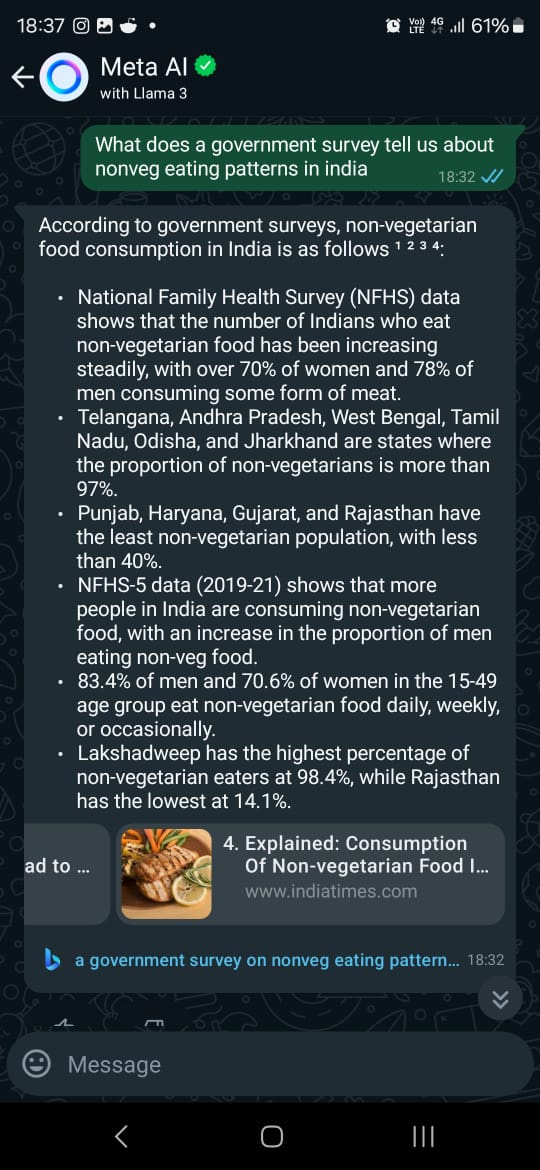
Search results have been bad for misinformation and wrong information because they feed into our confirmation bias, which then fuels our echo chambers.
On the contrary, search results tend to validate LLM training knowledge. I believe this is not a confirmation bias in LLMs because the LLM is not looking for or expecting a certain type of information that it may or may not like. Yes, it has biases, but the search validation does reduce the likelihood of hallucinations and builds trust in the user.
Coming back to Meta AI. It’s an AI assistant for quick, informal use-
cases in the middle of chats. But something like ChatGPT is a purposeful tool meant for continuous productivity.
The way I see it, Meta AI, with its location makes it more socially compatible than ChatGPT.